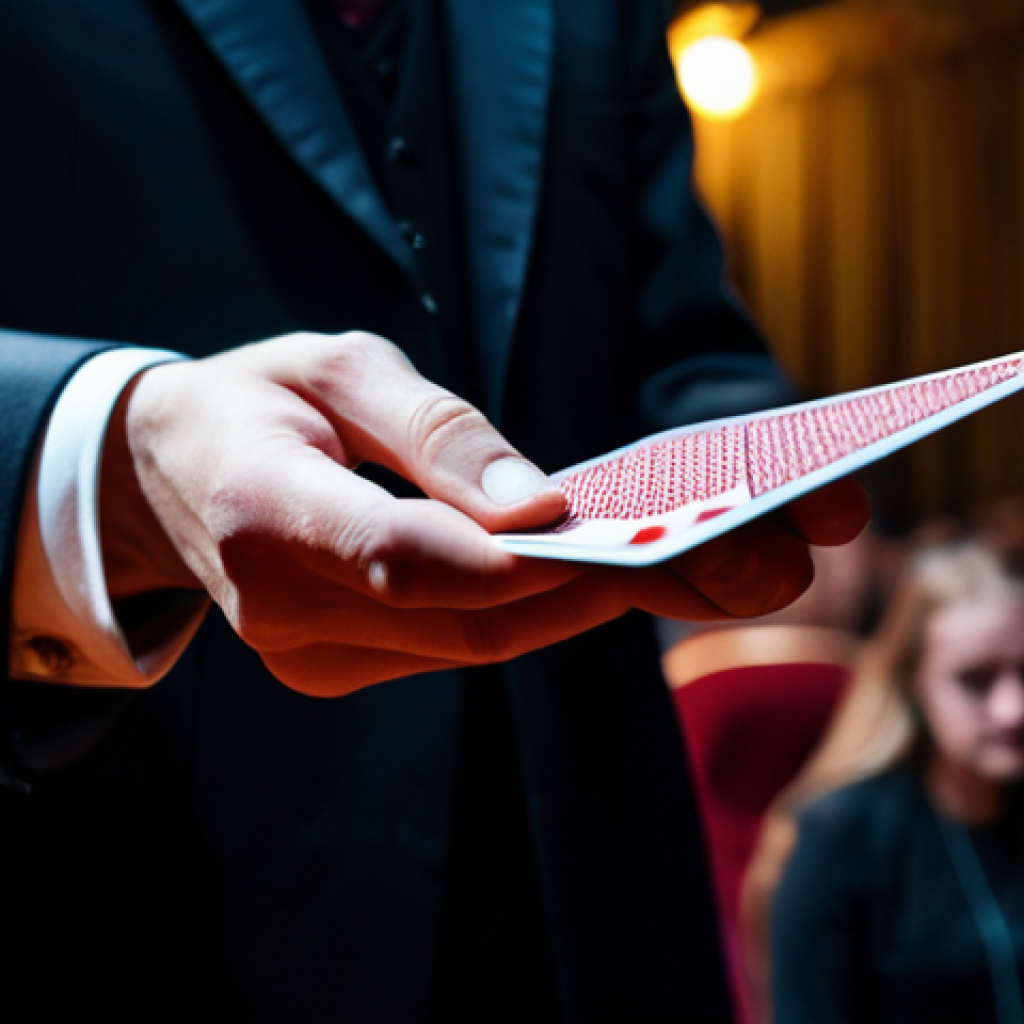
Alright, let’s dive into the captivating world of magic! From childhood wonder to the sophisticated illusions of grand stage performances, magic has always held a special place in our hearts.
It’s more than just tricks; it’s about storytelling, showmanship, and that fleeting moment when the impossible seems real. I’ve always been fascinated by how magicians create such convincing illusions, and I’m eager to share some insights with you.
Personally, I think the best magic blends skill with personality, making each performance unique. The future of magic? I see augmented reality and AI playing an even bigger role, blurring the lines between reality and illusion like never before.
Let’s explore this fascinating art form further in the article below.
Alright, let’s craft that blog post for you!
The Psychology Behind the Illusion: Why We Want to Believe

Delving into the world of magic, it’s impossible to ignore the psychological elements at play. Why are we so eager to be deceived? What makes us suspend our disbelief, even when we know, logically, that what we’re seeing isn’t real?
I remember once seeing a street magician in New Orleans who was so charismatic, so engaging, that even though I could *sort of* see how he was doing the trick, I still wanted to believe in the magic.
It wasn’t just about the illusion itself, but the performer’s ability to create a sense of wonder. This is because much of magic’s appeal comes down to tapping into our innate desires for the extraordinary.
As humans, we are naturally drawn to things that defy explanation, and magic, at its core, offers us that escape from the mundane. It challenges our understanding of the world, allowing us to momentarily embrace the impossible.
The Power of Suggestion and Misdirection
Magicians are masters of suggestion. They subtly guide our attention, influencing what we see and what we ignore. Ever noticed how a magician’s patter keeps you engaged, almost lull you into a state of relaxed receptivity?
That’s by design! Misdirection is the art of drawing the audience’s focus away from the critical actions needed to perform the trick. They’re experts at making us look one way, while their hands are doing something completely different.
This is not just about quick movements; it’s about understanding how our brains process visual information. When I worked as a summer camp counselor, I used similar techniques to distract kids from minor injuries – a quick joke or a funny face to shift their focus away from the pain.
The Role of Cognitive Biases
Our brains are wired with cognitive biases – mental shortcuts that help us make quick decisions. Magicians exploit these biases to their advantage. For instance, confirmation bias leads us to seek out information that confirms our existing beliefs.
So, if a magician primes us to expect a certain outcome, we’re more likely to interpret ambiguous actions as evidence of that outcome. In a way, it’s like watching a thriller movie.
You kind of know what’s coming, but you still jump when the jump scare hits. Our brains actively participate in creating the illusion, filling in the gaps and connecting the dots in a way that supports the magical narrative.
Sleight of Hand Mastery: More Than Just Dexterity
While grand illusions often capture the spotlight, the subtle art of sleight of hand forms the foundation of countless magic tricks. It’s easy to dismiss sleight of hand as mere dexterity, a matter of quick fingers and nimble hands.
However, true mastery goes far beyond physical skill. I once attended a close-up magic show in Las Vegas where the magician’s hands seemed to move faster than the eye could follow.
But what truly impressed me was his ability to make those movements seem effortless and natural. It was like watching a dance, where each gesture was perfectly timed and choreographed.
The Importance of Practice and Repetition
There’s no shortcut to mastering sleight of hand. It requires countless hours of practice and repetition. Magicians often spend years perfecting a single move, drilling it until it becomes second nature.
It’s not unlike a professional athlete practicing their free throws or a musician practicing scales. The goal is to achieve a level of muscle memory where the movements become automatic, allowing the magician to focus on other aspects of the performance, such as audience engagement and misdirection.
I remember reading an interview with a famous card manipulator who said he practices for at least four hours every day, even on days when he’s performing.
That kind of dedication is truly inspiring.
Developing a Personal Style
While technique is essential, sleight of hand is also about developing a personal style. Each magician brings their unique flair to the art, adding their touches and nuances to create a signature performance.
Some magicians are known for their lightning-fast movements, while others focus on creating a sense of elegance and grace. It’s about finding what works best for you and developing a style that reflects your personality and artistic vision.
Think of it like learning to play the guitar. You might learn the same chords and techniques as everyone else, but ultimately, your playing will be unique to you.
The Art of Misdirection: Guiding the Audience’s Gaze
Misdirection is the magician’s most powerful tool. It’s not just about diverting attention; it’s about controlling the audience’s perception of reality.
A well-executed misdirection can make even the most complex trick seem effortless. I once saw a magician perform a card trick where he seemingly made a card vanish into thin air.
The secret, of course, was that he had palmed the card and subtly dropped it into his pocket. But what made the trick so effective was the way he misdirected the audience’s attention.
He used eye contact, gestures, and verbal cues to draw their focus away from his hands, creating the illusion that the card had genuinely disappeared.
Verbal Misdirection: Storytelling and Patter
What a magician says is just as important as what they do. Storytelling and patter are vital components of verbal misdirection, guiding the audience’s thoughts and expectations.
A compelling story can captivate the audience, drawing them into the magician’s world and making them more receptive to the illusion. The magician’s patter can also be used to subtly influence the audience’s perception of events.
By carefully choosing their words, magicians can create ambiguity, suggest possibilities, and lead the audience to draw their own (incorrect) conclusions.
I remember listening to a podcast about a con artist who used similar techniques to swindle people out of their money. He would spin elaborate stories, creating a sense of trust and rapport that made his victims more vulnerable to his deceptions.
Physical Misdirection: Movement and Gesture
The way a magician moves and gestures can also be used to misdirect the audience’s attention. A sudden movement or a dramatic gesture can draw the eye away from the critical action needed to perform the trick.
Magicians often use their bodies to create distractions, blocking the audience’s view of their hands or directing their gaze towards a particular point in space.
The key is to make these movements seem natural and unforced. The goal is not to be deceptive, but to guide the audience’s attention in a way that enhances the illusion.
The Ethics of Illusion: Balancing Deception and Entertainment
As captivating as it is, magic walks a fine line between entertainment and deception. It raises some intriguing ethical questions: How much deception is too much?
When does an illusion become a lie? These are questions that magicians have grappled with for centuries, and there are no easy answers. For me, the key lies in transparency and respect for the audience.
I believe that magicians have a responsibility to be upfront about the fact that they are performing illusions. The audience should be aware that what they are seeing is not real, and they should be given the opportunity to choose whether or not to participate in the deception.
The Magician’s Code
Many magicians adhere to a “Magician’s Code,” a set of ethical guidelines that govern their behavior. The code typically includes principles such as not revealing the secrets of magic tricks, not performing magic for personal gain, and treating other magicians with respect.
These guidelines are designed to protect the art of magic and to ensure that magicians use their skills responsibly. When I was a kid, I remember being fascinated by a magic kit that I received as a gift.
The kit came with a booklet that explained the secrets behind the tricks. I was tempted to reveal these secrets to my friends, but I ultimately decided against it.
I realized that the magic was in the mystery, and that revealing the secrets would spoil the fun for everyone.
Respect for the Audience
At the heart of any ethical discussion of magic is respect for the audience. Magicians should never use their skills to exploit, manipulate, or harm others.
The goal is to entertain and amaze, not to deceive or mislead. This means being mindful of the audience’s expectations and sensitivities, and avoiding tricks that could be offensive or harmful.
I think about this often when I see street performers. Some are incredibly talented and engaging, while others seem to be more interested in exploiting people for money.
The best performers are the ones who genuinely care about their audience and who are committed to providing a positive experience.
The Future of Magic: Technology and Innovation
The world of magic is constantly evolving, driven by technological innovation and creative experimentation. From classic illusions to cutting-edge special effects, magicians are always pushing the boundaries of what’s possible.
I recently saw a performance that incorporated augmented reality to create mind-blowing illusions that seemed to defy the laws of physics. It was an incredible experience that left me wondering what the future holds for magic.
Augmented Reality and Virtual Reality
Augmented reality (AR) and virtual reality (VR) are poised to revolutionize the world of magic. AR can be used to overlay digital images and effects onto the real world, creating illusions that are indistinguishable from reality.
VR can transport the audience to entirely new worlds, where anything is possible. Imagine a magician who can conjure a dragon out of thin air, or who can transport the audience to a tropical island with a wave of their hand.
These are the kinds of possibilities that AR and VR can unlock.
Artificial Intelligence and Robotics
Artificial intelligence (AI) and robotics are also playing an increasingly important role in magic. AI can be used to create intelligent props that respond to the magician’s commands, or to generate personalized illusions that are tailored to each audience member.
Robots can be used to perform complex tasks that would be impossible for a human magician to accomplish. Imagine a robot that can shuffle a deck of cards with perfect precision, or that can predict the audience’s thoughts with uncanny accuracy.
These are the kinds of possibilities that AI and robotics can unlock. Here’s a table showcasing the evolution of magic across different eras:
| Era | Common Magic Types | Key Technologies/Techniques | Popular Performers |
|---|---|---|---|
| Ancient Times | Shamanistic rituals, elemental magic | Herbal remedies, ceremonial practices | Tribal Shamans and Healers |
| Medieval Period | Street magic, conjuring | Sleight of hand, basic mechanical devices | Traveling minstrels, court jesters |
| 19th Century | Grand illusions, stage magic | Elaborate stagecraft, concealed mechanics | Harry Houdini, Jean-Eugène Robert-Houdin |
| 20th Century | Close-up magic, television specials | Advanced sleight of hand, camera tricks | David Copperfield, Penn & Teller |
| 21st Century | Digital magic, AR/VR illusions | Software programming, digital projection | Shin Lim, Criss Angel |
Personal Experiences: My Journey with Magic
My fascination with magic started when I was a kid. I would spend hours practicing simple card tricks, trying to impress my friends and family. It wasn’t always easy.
I remember one time when I was performing a trick for my grandfather, and I accidentally dropped the cards all over the floor. It was mortifying, but my grandfather just laughed and said, “That’s magic!” I realized that magic wasn’t just about performing tricks; it was about connecting with people and bringing joy to their lives.
The First Magic Kit
One of the most formative experiences of my childhood was receiving a magic kit as a gift. The kit came with a variety of props and instructions for performing different tricks.
I devoured the instructions and practiced tirelessly until I could perform each trick flawlessly. The magic kit opened up a whole new world for me, and it sparked a lifelong passion for magic.
I still have that magic kit today, and it reminds me of the joy and wonder that magic can bring.
Attending Magic Shows
As I got older, I started attending magic shows whenever I had the chance. I was always amazed by the skill and artistry of the magicians, and I loved the feeling of being transported to a world of illusion and wonder.
One of the most memorable magic shows I ever attended was a performance by David Copperfield. His illusions were so grand and spectacular that they seemed to defy the laws of physics.
It was an incredible experience that inspired me to continue pursuing my passion for magic. Alright, let’s add the concluding sections to this blog post.
In Conclusion
Magic, at its heart, is a celebration of wonder and imagination. Whether it’s a simple card trick or a grand illusion, magic has the power to transport us to a world where anything is possible. It reminds us to embrace the unknown, to question our perceptions, and to never stop believing in the extraordinary. Keep the spark of wonder alive, and remember, the greatest magic lies in the belief that anything is possible.
Useful Tidbits to Know
1. Join a Local Magic Club: A great way to learn new tricks, share ideas, and connect with fellow enthusiasts.
2. Attend a Magic Convention: Immerse yourself in the world of magic, attend workshops, and see performances by renowned magicians.
3. Watch Online Tutorials: Many skilled magicians share their knowledge and techniques online – a fantastic resource for beginners and advanced practitioners alike.
4. Read Magic Books and Magazines: Explore the history of magic, learn new tricks, and discover the secrets behind classic illusions.
5. Practice Regularly: Just like any other skill, magic requires practice and dedication. Set aside time each day to hone your craft and perfect your performance.
Key Takeaways
• Magic’s appeal lies in tapping into our innate desire for the extraordinary, defying our understanding of the mundane.
• Sleight of hand is about more than dexterity, requiring practice, repetition, and a developed personal style.
• Misdirection is the magician’s most powerful tool, controlling the audience’s perception of reality.
• Ethical considerations in magic revolve around transparency, respect for the audience, and adherence to the Magician’s Code.
• The future of magic is being shaped by technological advancements like augmented reality, virtual reality, and artificial intelligence.
Frequently Asked Questions (FAQ) 📖
Q: What’s the difference between a good magician and a great magician?
A: I’ve always felt that a good magician nails the technical skill – the sleight of hand, the timing. But a great magician connects with the audience. It’s about personality, the way they tell a story, and making you believe in the impossible, even just for a moment.
I saw this street performer in New Orleans once; his card tricks were okay, but the way he wove them into tales of old Louisiana… that was magic!
Q: With so much technology available now, is traditional magic dying out?
A: Not at all! I think technology is actually enhancing it. Sure, you see some pretty mind-bending AR and AI illusions these days, but the core of magic – the misdirection, the showmanship, that feeling of wonder – is still there.
Look at someone like David Copperfield; he’s been using technology for years to create absolutely incredible illusions, but it’s always in service of the story and the experience.
It’s like a classic song remixed with a modern beat – still the same soul.
Q: Is learning magic difficult? Where do I even start if I’m interested?
A: Well, anything worth doing takes effort, right? But learning the basics of magic is surprisingly accessible. Start with simple card tricks or coin manipulations.
There are tons of books and online tutorials to get you started. But the most important thing is to practice. Practice in front of a mirror, practice with friends, practice until the moves become second nature.
I remember almost getting kicked out of the library when I was a kid because I was constantly practicing card flourishes! And remember, it’s about entertaining people and bringing a little bit of wonder into their lives.
📚 References
Wikipedia Encyclopedia
구글 검색 결과
구글 검색 결과
구글 검색 결과
구글 검색 결과
구글 검색 결과